THE PHOTOGRAPHERS' GALLERY
TWO GREAT EXHIBITIONS!
http://thephotographersgallery.org.uk/home
FIONA TAN: VOX POPULI, LONDON
15-30 SEPTEMBER
Vox Populi, London was commissioned by The Photographers' Gallery as part of our Soho Projects, sponsored by Bloomberg.


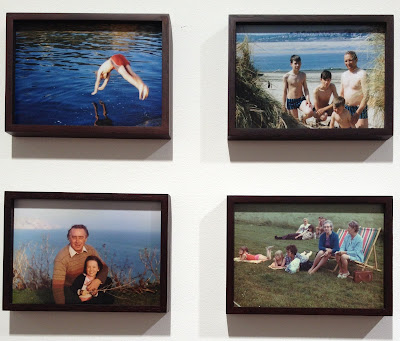
Vox Populi, London was commissioned by The Photographers' Gallery as part of our Soho Projects, sponsored by Bloomberg.

Fiona Tan born in 1966, Indonesia, but based in Amsterdam exhibits Vox Populi, London- the final instalment of a series that has included Norway, Sydney, Tokyo and Switzerland. The work she exhibits here features a diverse range of family albums which she has collect throughout 2011, all contributed by Londoners. The collected images focus on the every day and various other subjects of celebratory moments, with tourist landmarks, front rooms, family portraits and sports fields of London.
There are more than 250 images from over 90 participants which make up the final outcome and is presented here for the first time.

An accompanying artist's publication, including a text by Brian Dillon, is co-published by The Photographers' Gallery and Book Works and is available in the Bookshop.

This exhibition is very striking on first appearance and from a distance you can't see the images which is quite mysterious but clever because you have to approach the work face on and quite close-up. The way it has been displays resembles a house with family photos on the wall, although this is an extreme version of over 250 images. Up close you start to see all these animated pictures of adults and children, all quite private and intimate, as if just pulled out of your treasured album in a cupboard. I like this exhibition because you can really relate to the images in some way or another even if it's just a few of them.


The images make you smile and they create a very nostalgic feel that makes you think about your own life and possibly your childhood too. Although taken from the London area, it makes you realize that everyone is the same in terms of family and how you choose to record the everyday, celebrations, day outs and traditions, and you start to think about your own photographs. It also amazes me how Fiona Tan has chosen to use other people's photographs and not her own, but decided to turn them into her own piece of work. It makes me think about my own practises and that you can turn anything into a Art if you have a reason to do so.
The work really made me 'feel at home'.
FRESH FACED + WILD EYED
15-30 SEPTEMBER 2012


Hanging
Glacier, Alison Stolwood
Course: MA Photography , University
of Brighton
The distinctions between natural and
artificial interest Stolwood. Her work looks to highlight the impossibility of
fixing these distinctions, through camera technologies, notions of time, change
and her perception of things in the world. Constructing and isolating with the
lens she often builds up work in montage or multiple frame, wielding visual
mechanisms to study her ‘surrounding of infinite complexity’. The work studies
life, she has focused on a ‘constructed and technological landscape’.


Fresh Faced +Wild Eyed showcases the work of recent graduates from across the UK. Now in its fifth year, this annual event highlights the huge diversity of photographic practices emerging from UK institutions.
You can see the work of all 22 selected photographers and artists online at:
The Judges for 2012 are Bridget Coaker, Night Picture Editor, The Guardian and co-founder of Troika Editions; Anothony Luvera, artist, writer and lecturer; Karen Newman, Curator, Open Eye Gallery and Brett Rogers, Director, The Photographers' Gallery.
(Some of the Information used below has been quoted from the leaflet at the exhibition)

Timothy McVeigh’s Last Meal,
Helen Thompson
Course: BA Photography; Editorial
and Advertising, University of Gloucestershire
This work represents Death Row Prisoner's Last Meals. In this work
the artist has considered which meals would be most interesting to photograph
and created a still life for each meal with a dark background and low-lighting
to create this minimalist effect and the 'starkness of prison'.

EU Parliament, Brussels,
Paul-Henri Spaak Building, Room 04B001 and 03H01
Course: M.A. Photographic
Studies, University of Westminster
This series represents the
interiors of the European Parliament in Brussels and Strasbourg. Despite not
being understood or liked by many citizens, it is gaining a prominent role in
our everyday European lives.

Hanging
Glacier, Alison Stolwood
Course: MA Photography , University
of Brighton
The distinctions between natural and
artificial interest Stolwood. Her work looks to highlight the impossibility of
fixing these distinctions, through camera technologies, notions of time, change
and her perception of things in the world. Constructing and isolating with the
lens she often builds up work in montage or multiple frame, wielding visual
mechanisms to study her ‘surrounding of infinite complexity’. The work studies
life, she has focused on a ‘constructed and technological landscape’.

Freediver
Portraits, 4 metres, Emma Critchley
Course:
MA Photography, Royal College of Art
Critchley's practice here
focuses on the experience of being submerged in water, and the notion of being.
It looks at how different we become when taken out of the normal everyday
situation and how our 'structure of being changes' underwater. It
explores how the body has to rely on breathing to stay conscious and how
reminds us how fragile our life really is.
This work was really interesting to view because although it is quite disturbing to see someone completely submerged in water, it has quite a calming appearance and makes you almost feel like you're in the subjects situation, being in this 'bubble' of alien surroundings. For a human this isn't natural to be standing under water, however thinking about it, for 9 months of our lives this is what we were doing, 'naturally'.

Closer
Than Known, Chloe Sells
Course: MA Fine Art,
Central Saint Martins
This work demonstrates the idea that 'Land' which we relate our entire
lives, memories and history to, 'exerts a subtle power over us'. Darkroom
processes dominate her style of working and here the images are layered with
bright colours and geometric folds, 'creating an atmosphere of the unreal'.
I loved this work for its vibrancy and its creativity. I really like the experimentation aspect of it and how Chloe Sells has explored the traditional printing processes in an artistic way and creating something aesthetically pleasing but also with an in depth concept that has been explored in an unusual and different way.

Coral,
From the series, Light of day, Hallgerdur Hallgrimsdottir
Course: BA Fine Art
Photography, Glasgow School of Art
This is an interpretation of Hallgrimsdottir's home, Iceland, which he
calls, 'vulnerable' and tells us, 'it is not an all-inclusive a holiday'. 'This
is a fragmented voyage through memories and dreams, some of which we long to
relive, but cannot, other we yearn to forget, but cannot.
This is a piece that we as the audience have to judge for ourselves, and
imagine our own thoughts on the place. Light of day is a collection of
found images and some of his own.


Untitled
6, from the series Dark Collection, Vilma Pimenoff
Course: MA
Photography, London College of Communication
This work features strange objects that appear different depending on
the angle, lighting and 'the viewers psychological predisposition'. The work
explores the process of visual perception, the difference of seeing an object
and understanding what we see. The word associated is 'Wunderkammer'
which is a collection of strange objects that look as though they are alive
bringing us back to our childhood and the thought that the shadows create
shapes in the dark.
I didn't really know what to think when I first glanced at this work, as
visually it's very abnormal but wierdly, has quite a hypnotic effect on you.
The tones and the light create abstract shapes from the objects that are
strangely placed, but look smooth in texture and ghost like. By blending the
the background with the objects makes you imagine these 'make belief' beings as
real life, which definitely makes you thing about your own perception on
things you see.

Air,
From the series Attempts, Minna Pollanen
Course: MA
Photography, London College of Communication
This work was made on a small family island which maps out the notion of
'land ownership'. The images contain, collect and mark out different
parts of the landscape and explores geographical elements within them. There is
a question of 'how anyone is able to own land? and what does the ownership
actually constitute of?'

Source, Helen
Goodin
Course: MA
Photography, Univeristy for the creative arts, Farnham
The key
factor of Goodin’s work is the question of what photography is and what the key
to the production of the photograph is. ‘Her answer is light’. Experimenting in
the darkroom, she plays with light, exposing it onto photographic material. The
circular form is the ‘pinhole’ the, bases of most photography, what one sees
from this simple form is to each person’s own interpretation.
This in interesting yet in a way quite simple idea, however it is a subject that everyone has to think about when practicing the subject of photography and it has been effectively demonstrated here by Helen Goodin. I like the minimalism of the work as is grabs your attention and makes you want to find out more about it.

Compressed
reality, Seo-Yeoung Won
Course: Fine
Art Media, MFA Slade school of Fine Art
The work is centred
on the relationship of objects and space. The studio is used to experiment the
idea and to interrogate these issues. The common objects have been removed from
their normal, everyday space and charged into a new space of the studio. This creates
a collection of installation art, painting, photography and ‘perspectival experimentation’.

I have troubles [...], Martin Seeds
Course: BA Photography, University of Brighton
This work explores the idea of cultural identity with an
attempt to come to terms with Seeds own heritage. Seeds has lived in England
for many years but coming from Northern Island has made him think about and
inadvertently reject his own culture and history and ‘necessarily rejected the
violent history of where he came from’. He returned to Northern Island to make
this work, actually using his iPhone and here displayed as contact prints, he
made the work not as a document but as an aide to search for a ‘deep sense of
origin that he believes exists in us all’.
These images are different to what you normally expect in a
gallery as they are images from a phone and this is something I can relate to
as I feel you don’t have to have expensive equipment to create a piece of work
and this work just shows anyone who disagrees with that idea, that it really isn’t
how you make the work but it’s what it means and how you interpret it at the
end. Although the quality is different and a lot slower than a DSLR or
medium/large format camera I think the blurry, softness of the image adds a
dramatic effect to the meaning behind the work.

Moronic, Daniel Evans + Brendan Baker
Course: BA Photography, University for the creative Arts,
Farnham
This is the first piece of work produced by the duo above.
The work centres on the idea of language and the human process of understanding
it.
Thank you for reading and feel free to comment!