Showing posts with label art. Show all posts

Friday, 10 January 2014

LANDSCAPE PROJECT


Hi Everyone!


It's been quite a long time since I last posted but as I have just finished my recent project for Uni I have decided to create a post about it!
So this is a portfolio submission of 5-10 images, min A3, max A2 in size and the subject matter was pretty much open to interpretation and in my case it was going to be Landscape all the way! (of course). 
I have always been interested in Landscape whether it's photography or paintings mainly because of the aesthetics and general beauty about it. I also love how we can interpret so many different social/political issues in Landscapes which again makes this subject so interesting.
So as I have also written a project report which will also be submitted, I will post it here for you to look at!

Feel free to tell me what you think, I am open to comments!


Project Description


My work is particularly focused around the idea of change in Landscape Photography, in particular ideas of habitation and spaces or places that have been ‘interacted’ with. There has been an exploration of the area, Basingstoke (Winklebury) which is my hometown which suggests a relationship between photographer and the environment; which emphasises the idea of human existence within a natural space and our continuing relationship with the land. The work has developed by continuously walking and exploring a place with a connection to nostalgia and ideas that I can relate to. The images have become a representation of discoveries, weather, and seasonal occurrences of the past few months; revisiting and taking different routes in that particular area.  All the images appear to have a sense of mystery within them, specifically the paths, the in-closed places and public spaces.  Influences and ideas into similar themes have been from the work of Jem Southam, Virginia Nimarkoh and 19th Century painters; (but not limited to) who represent places that have been or are still in use and continue to document and revisit these particular spaces. The work also aims to address the ideas and differences around Landscape paintings and photography, and how images create awareness about social, political, personal and various other issues; focusing primarily on conceptual and aesthetic meaning and understanding how the traditional ‘picturesque’ approach of 18th/19th century art has influenced are interpretations of  the modern landscape.


Project Development

The work began by exploring the surroundings of my home and familiar places by walking and shooting; developing a feeling for the area and knowing what works with the current weather conditions. After looking at traditional pieces of work of wide-open spaces and beautiful scenery I felt as though my work was venturing into a more pictorial approach and a combination of human and natural intervention. The idea of re-visitation constantly provokes me into going back to the same places at different times and different days to develop a journey or story like aesthetic. During the pin-up sessions I wanted people to feel like they were or could be in the picture, feeling a sense of familiarity and a connection between themselves and the place. Although the images are made in a place I personally can connect with, I didn’t want this to restrict the ideas that people have. I would like to believe that the Landscapes I produce, leave the mind open to interpretation, getting the viewer wondering about that particular place, who has walked there, sat there or what is it used for. 


First Shoot in Southampton (Construction site/Park)

Whilst continuing to look at many images of other artists or photographers; particularly to develop an understanding of the changes and differences landscape art has been through, I go out on foot making images that just feel right, places that just catch my eye. Most of my images contain traces of human presence or man-made objects within them, for example paths, benches, and general public spaces. Picturing the paths specifically has become something I subconsciously do as my intentions are not to produce images of paths but are to capture places I have been or others have been. My first shoots in general were quite vague in terms of meaning and intentions, the aim was to explore areas and show a relationship between man and nature, and how we have changed the land and developed a sense power over it. I started making images of Southampton, particularly around the parks, where we have a common interaction, and where there is evidence of nature/man influences, specially buildings and trees. From these images I received feedback on the lines of, ‘More nature, not so much landscape’, ‘a sense of direction’, and, ‘interesting framing’. The feedback sessions were very helpful in the process of elimination and which direction to head in next. From then on I focused on where I was most familiar with, places I knew my way round and generally where I felt most connection with and the work started to become more fluid and interesting. In terms of meaning, the work has developed into a way for many people to see images of the everyday, which create an awareness of the things that are happening in the areas in which we live. A mixture of nature and human existence really creates the contemporary feel and is an interesting way of showing our ever expanding use of the land. In terms of aesthetics and the traditional image, there are aspects of this through the use of the natural environment, the images do not always suggest beauty and romance but sometimes a sense of the forgotten and nostalgia in the surrounding the areas.


First shoot (Southampton Park)


Second Shoot (Basingstoke/ Winklebury-‘Tire-Swing’ Park)


Third Shoot (Sycamore Community Centre- Winklebury)


Fourth Shoot (Winklebury Basketball Courts)


Fifth Shoot (Sunset- Winklebury Playing Fields)


Sixth Shoot (Foggy- Winklebury Playing Fields)


Visual Research

The research for this project mainly involved the work of landscape photographers and landscape painters, particularly Virginia Nimarkoh and Jem Southam, who create narrative explorations about familiar and common places. Also Ernst Haas (20th Century photographer), who combines traditional techniques with the contemporary, picturing nature and the modern world together. In essence the photographers mentioned and 18th/19th century painters, J. M. W Turner and Caspar David Friedrich, have influenced my work with their paintings and the many scenic places that they offer, with the ideas behind ‘aesthetics’ of images, in particular the beauty and sublime. 


Jem Southam- The Pond on Upton Pyne

The Photographer Emily Shur was an influence from the start, focusing on the relationship between human and environment, whether it was outside or inside, there is always a connection either way. Eric Bessel and Jennifer Ray show how the land can be formed into other shapes and formations through installation and purely by our involvement and intervention. I have been very interested in how landscape photography has majorly become about how we ‘use’ the land rather than how we see the land and also a demonstration of man-made structures within a natural space rather than a purely natural, untouched environment, because realistically it doesn’t exist.


Emily Shur- Parking Lot, Arizona


Photographers Young Suk Sun and Carl Gunhouse portray these ideas with the use of pylons, roads and billboards within transformed natural environments. The ideas mentioned only help to support my existing ones; along with the images I produced that aim to help viewers create their own interpretations of the landscapes I make of


Virginia Nimarkoh- Urban Utopias

the every day, familiar spaces. Going back to the past and looking at older landscapes has helped me to realise why it’s so hard to produce a ‘natural’ image of the environment and how photographers and painters today struggle to find the wide open vistas that were much commonly demonstrated in the 17th-19th centuries. The work of Eugene Atget shows the beginning of experimentation with architecture and nature and is yet to be restricted to landscapes that feature human presence. Romantic painters, J. M. W Turner and Caspar David Friedrich, also explore these ideas above and although the difference of their work is how they produce it, the reasons why they make the images are similar to why photographers do. Landscape is about showing of the land, showing people what’s out there, creating a relationship and connection between us all.


 J.M.W. Turner


Ernst Haas- Monument Valley

Project Conclusion

The final images I have chosen show evidence of change in terms of weather and demonstrate a ‘journey’ which I have experienced by continuously photographing the same area. The formation of the series, works in showing images taken near to the beginning of the project and then gradually towards the end, with obvious changes in conditions and natural occurrences. Another aim for the project was to provoke a message of change in Landscape art and to emphasise the need to demonstrate the progress in which artists and photographers share; from barren waste lands to cultivated farming to thriving villages, commons and enclosures; becoming accustomed to the changes in society, and developing relationships with the land around us. Landscape has become about uses of land instead of views of the land, images of personal places rather than new places; one might question the notion of beauty when it comes down to issues around the idea of land.
I believe my work shows an understanding of how landscape works, how certain conditions (weather/time of day etc) depend on what images you produce and of the thinking and meaning behind each image. I have found it hard to eliminate certain images from the series, but at the same time, found it hard to make a series because I believe the images work individually as well. The next page demonstrates the layout I feel best suits the images (This could change if exhibited). The series has been put together by thinking about a specific pattern in which I followed, specifically the days in which I made the images, and showing the differences and changes in the seasonal conditions, especially the colours. It was important that the images had a picturesque aesthetic as well as showing our relationship to the land and habitual space around us.


Thank you for reading!

Visit www.facebook.com/rosieknightleyphotography for more work or equally visit my flickr page and like!
http://www.flickr.com/photos/58999424@N03/
Follow me on Twitter:
https://twitter.com/RosieK1992


Friday, 21 December 2012

INSPIRED BY BENCHES


Frensham Ponds, Surrey, UK

Frensham Ponds, Surrey, UK

The Vyne, Basingstoke, UK

The Vyne-Basingstoke, UK

What do you think of these benches? I don't know about you- but I really have a thing for them! The messages are just so inspirational, they really make you think as you're walking around the area.
I have been thinking about trying to find more and creating a Typology of them, sounds quite fun. They seem to be situated in nature walks/ parks and National trust sites, but so far I've only seen them in two locations, but would love to see more.
Tell me what you think!

Wednesday, 9 May 2012

INSTAGRAM LOVE


Instagrammers!


There has been a debate about the successful smart phone application, Instagram. Uploading and sharing photographs you have or haven't taken with your phone and then changing the filters (or not) to create something new and interesting whether it took them 1 minute to a whole day. The debate here is that aspiring photographer's and professionals alike have been concerned to whether the app adds value to the photograph or even classifies as "photography". Another debate is to whether people who don't study the subject have become or are oblivious to the skill, creativity and technical aspect to any kind of photography.


I am discussing this because I am a fan of Instagram, and I believe that any photo, belongs to the subject, "Photography" because when isn't a photograph a photograph? There are people people who believe that it isn't good enough to make you a pro, but then why are there so many people who use it? 


I have been using Instagram for quite a while now and it has never really occurred to me whether it changes the value of photography or not. I use it to share my photos with other people, experiment with the filters it gives you and really for a bit of fun and to pass the time! I also enjoy seeing what other people have made and there really is some amazing work. 


Instagram has expanded its reputation rapidly in such a short space of time and I don't think people should regard it as competition at all. People can share what ever they like, there are no restrictions and no expectations, some people even share their dinner with us!


I have never thought that anyone was judging me and that's why I have always liked the application itself and to be honest it's quite a buzz when people "like" you photo or even follow you. I agree that there is some amazing photography on there and that's one of the reasons why I use it, however there are many people with 1000's of followers with pictures purely of food, or images uploaded from the internet, so I don't consider the app as a gateway to photography as not everyone is there for that, it's just what ever floats your boat at the time and sharing your experiences with the world.


Another point I will raise is that It encourages the use of mobile photography, and for me this does not effect whether you are good or bad at photography it's "how you use it" that counts. We as students in photography are always encouraged to experiment and explore the different ways and techniques of other equipment other than DSLRs, and I totally agree that you can make some equally as good images.

I have shared some of my images from Instagram. Visit my  Instacanvas gallery at:

instacanv.as/rosieknightley


Please share your thoughts and opinions too.


Have some fun with Instagram now!


Thursday, 26 April 2012

ORI GERSHT


ORI GERSHT: 
THIS STORM IS WHAT WE CALL PROGRESS
25 January 2012 to 29 April 2012

Here is another exhibition piece which I thoroughly enjoyed once again, Ori Gersht is a great artist and hugely inspirational!
This exhibition was quite surreal on first impressions, the work is very abstract and conceptual which makes it very interesting aesthetically. Many of the events featured in Gersht's work centre around World War 2 and the title was derived from an essay by German Jewish philosopher Walter Benjamin.

Gersht re-examines our relationship with this debris through film and photography. (debris of past events.) He uses photography as a metaphor for history and explores the representation of past and present and the links and ruptures between physical traces, cultural symbols and memories.

Gersht is concerned with the relationship between history, memory and landscape. He adopts a poetic and metaphorical approach to explore the difficulties of visually representing conflict and violent events or histories. 
He also pushes the technical limitations of photography, questioning its claim to truth. 


Ori Gersht, 2011
CHASING GOOD FORTUNE: HIROSHIMA SLEEPLESS NIGHTS, NEVER AGAIN 01


Ori Gersht, 2011
CHASING GOOD FORTUNE: TOKYO IMPERIAL MEMORIES: FLOATING PETALS-BLACK WATER 

Ori Gersht used a digital camera at night to create his "petal" work, however the camera sensor struggled to record the correct light and colour information, resulting in stippled images, referencing early colour prints.
Gersht uses this visual "failure" as a device to explore the idea that photography does not present an absolute truth or narrative.

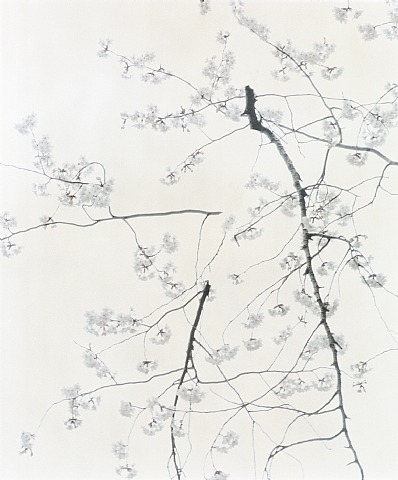
In his images of the "Cherry Blossom", taken in a memorial garden, was photographed at a shrine to Kamikaze pilots, the flowers became loaded with a dark, recent history. Simultaneously the images are beautiful, more positive connotations of the flower in the Buddhist tradition. It reveals complexities of trying to impose a single reading on an image.


WILL YOU DANCE FOR ME
HD FILM
"YEHUDIT ARNON"
The film is about a women who suffered a traumatic childhood and is imagining it all over in a dream like situation. The (old) women is sitting in a chair, now unable to dance like in her younger years, rocks back and forth in an uncomfortable manner with a separate screen featuring a field of thick, deep snow,  the setting she may have experienced many years ago. 
While she was a prisoner in Auschwitz, aged 19 she was ordered to dance at an SS Officer's party. She refused and was punished by making her stand barefoot in the snow. At that point she made a pledge that if she survived she would devote her life to dance. Later she fulfilled her dream with a successful dance company.


If you like the minimalist or abstract style of Art work please check out this website for some more images:

http://crggallery.com/artists/ori-gersht/ 


Wednesday, 14 March 2012

THE HOLBURNE MUSEUM


Art of Arrangement: Photography and the Still Life Tradition
11 February to 7 May 2012 


This exhibition explores the use of objects within a Still Life and how Artists and Photographers have experimented with techniques and ideas over many years. It holds the works of Artists/Photographers, such as Ansel Adams, Edward Western, Dorothea Lange, Paul Strand and many more masters of the Art world.
It was fascinating to see such rare and one-of-a-kind prints in one room and to have this opportunity that might not come again.

I have chosen particular pieces of work from each section of the exhibition which will be underlined and these were the ones that I drew my attention to aesthetically and technically. However the images were not allowed to be photographed close-up and some are not found online either, obviously for issues of preservation etc..


View of the Gallery


On Close Inspection
William Henry James Coombs, Negative radiograph of Tulip
(Gelatin Silver) Unfortunately no image.
A radiograph is an image produced on a radiosensitive surface, such as a photographic film, by radiation other than visible light, especially by x-rays passed through an object or by photographing a fluoroscopic image. Also called shadowgraph, skiagram, skiagraph.


For example: 

Floral Radiograph of a Rose produced by Albert Richards
 Floral radio-graph, produced by Albert Richards


Arrangments in negatives
The grouping and positioning of different parts of a photograph.
The images displayed are very unique in style and demonstrate technical ability and creativity and are very artistic. Now knowing how these images were produced makes you aware of the skill and time put into each one.


 Jerry Ulesmann, Memory and the sun,1966

 
Henry Peach Robinson, Fading Away, 1858
(Used several negatives to produce one photograph)


Still Life in a camera
The passing of time, fleeting nature of life, particular arrangements, carefully positioned equipment, framing and cropping.
The work is quite abstract and relates more to "Art" photography compositionally and aesthetically because of the way it's constructed. You are given the opportunity to explore the image further into detail by cropping from a much varied image.
Edward Western, Detail of Abandoned Car, Mojave Desert, New Mexico, 1937


Ansel Adams, Moth and Stump, Interglacial forests, Glacier Bay, National Monument, 1949

Reflection on light and dark
Photography and light
Natural and artificial
This work is quite experimental in terms of lighting and it's interesting to see how one interprets different settings and objects with different ways of light. Light can illuminate, highlight, accentuate or alienate a subject depending on the situation and the artists' intentions.

Paul Strand, Photograph-New York, 1916


Order and Disorder
Objects carefully selected and ordered to create a visually pleasing or meaningful image.
This sort of work makes you wonder whether you could call it "staged" photography or unrealistic, however I feel if you use the objects that belong to that particular space you are not manipulating the scene or reality in any way as there hasn't really been any interference. 
James Jarche, George Bernard Shaw's work table, 1939
Ian Beesley, Pieces, Drummond's Mill, Bradford 1986
Dorothea Lange, Corner of the Dazey Kitchen, 1939


Still life with the figure
Human figure is not the primary focus, important part of wider arrangement
Illustrates personality or artistic practise, or symbolic, meaningful things.
These images are very beautiful and the artist's have been very subtle in their approach to using the figure within their work. In some of the photographs there are only hints of a person whereas others have a face of the body, representing or meaning something as part of the image.
Chris Killip, Royal Wedding table, 1981
 

Horst P Horst, Gloves, New York, 1947

 
Julia Margaret Cameron, The Return After 3 Days


The Subversive
Records events, mortality, passing of time, political or personal messages.
Jo Spence, Still Life, 1985
Spence documented her body ans surroundings during her treatment of cancer, it was a sense of self which she then coined the term, "photo-therapy". Her work is very inspirational and political and sends messages to everyone who may have gone through similar experiences as herself.
Karen Knorr, A young nobleman's introduction to knowledge, 1984
This work was specifically about country life and the British class system.


A Dialogue with painting
"Vanitas" 
These paintings contain a moral or religious message, a shortness of life and inevitability of decline and death. They also contain long exposures of time with the still life being ideal to represent this.


Roger Fenton, Still Life with parian vase, Grapes and silver cup, 1860
The painter is mirrored in the goblet, were these his intentions, or just a happy accident? 

Movement and Stillness
They freeze a moment in time, stop and reflect and show action.
Cutting the Card Quickly .30-Caliber Bullet through the Jack of Diamonds

Harold Edgerton, Bullet through a jack of diamond, 1955


Philippe Halsman, Dali Atomicus, 1948

The iconic image of Salvador Dali is questioned by many at how this piece was constructed and seeing it for the first time allowed us the answer to just this.
The objects were suspended by thread, with the help from an assistant that held the chair and everything else thrown into the air, all very spontaneous. The whole production took 6 hours with 28 throws. The final image was the only successful one out them all.

The Holburne Museum in the City of Bath and the exhibition, "Art of arrangement", is definitely worth going for.