Showing posts with label portraits. Show all posts

Thursday, 26 April 2012

WAR STORY


War Story: 
Serving in Afghanistan
Imperial War Museum

Walking into the exhibition space you immediately get taken back by the array of photographs lined up along the outside of the walls. The powerful and striking portraits of the men and women serving in Afghanistan hit you in the face like you've just witnessed what they experience day to day. The project features interactive displays and photographs which demonstrate the soldiers first hand experiences of the conflict for present and future generations. (Information taken and available from The Imperial War Museum Website)


The idea is for people to get a chance to discover the compelling stories of the individuals and witness the collected material for the first time being put on public display. Most of the artefacts, videos and photographs are described and explained in the words and voices of those that that wore, used or created them.

Over 40 life size portraits feature in this exhibition which were taken and produced by Richard Ash and Damon Clearly. (Visit Richard Ash's website) Over 500 individuals were photographed for this project and it tells a compelling story through the eyes of many.


The process appears quite systematic visually but also technically due to the clean white backgrounds, (usually) no berets or insignia identifying their units, composed and processed in the exact same way and the consistency and conformity has instead highlighted the variety and individuality.


The direct gaze into the lens towards the viewer is unsettling yet intriguing which makes you wonder about the nature of their experiences. You get a glimpse of the person behind the uniform.
I enjoyed getting up-close and personal with these portraits, as if you were stood face to face in person with them, you can see every inch of detail in their faces, the lines, the worries and stress and emotions written all over. You feel a whole lot of sympathy with the brave and 
honorable soldiers.


"They are just like you or me. They are your brother, 

your dad, your sister, your best friend, your husband, 

your wife"- Richard Ash IWMP


Thursday, 19 April 2012

ALL ABOUT EVE


ALL ABOUT EVE: THE PHOTOGRAPHY OF EVE ARNOLD
Art Sensus, London Gallery

Another fab review on someone very inspirational, Eve Arnold, see what you think!

Walking into the exhibition, I had no expectations, no idea of the work she produced, but at first glance of her portraits of Marilyn Monroe and I was captivated.
Eve Arnold developed her career with very little formal training and travelled the world creating an unforgettable document of her journey. In 1952 she was taken on as one of the few female members of Magnum photos, which would have been huge achievement for any photojournalist. 
The content of this post has been gathered from the exhibition itself and some of Arnold's own words, at Art Sensus in London.


 Marilyn Monroe, Mount Sinai, Long Island, 1955
Cibachrome

Eve Arnold photographed Marilyn Monroe over a period of 10 years and runs like a thread throughout her work of the fifties in America. Arnold met Marilyn when they were both young and starting out in their careers and they developed a close bond and friendship.
The idea of her work was to forge a relationship which permits an atmosphere in which the subject feels relaxed and safe. Intimacy allows the person to be inhibited and reveal aspects of herself.


Marilyn Monroe, The Misfits, Nevada, USA, 1960


Isabella Rossellini, England, 1985


Angelica Huston at 16, Saint Clerans, Ireland 1968
Cibachrome

On working on films, 1959-1984
Eve Arnold documented the making of feature films, sometimes assigned by a motion picture company, sometimes a magazine. Locations are often more interesting and exotic then a photographic studio.


Clark Gable, The Misfits, Nevada, 1960


Francis Bacon in his studio in Kensington, London 1978

Driving force behind her work:
"Curiosity" was a constant challenge, The very unpredictability of photography enthralled her. Decisions of what to include, the framing, the trying to define the moment, the light moving across the face, kaleidoscope of emotions.
"I was hungry for answers led me to learn the profession to travel the world"
She was a one women cultural exchange.


Bar Girl, Cuba, 1954

On Photography
Everything was assigned but most of her work was based on her own ideas. The nature of the work leaves the decisions to the photographer. It is always a game of chance, fugitive and ephemeral. 
The terms used by photographers to express the mediums mutability:
Catch, grab, capture and seize. 
The things Eve Arnold did in the first few years were done by chance.

Eve Arnold visited Long-Island, the home of her family and friends, including Marilyn Monroe which triggered the "Nostalgia and affection" in her work.
Arnold spent 4 months in a hospital recording the first 5 minutes of the birth of a child. (she lost her own baby in mid stages of pregnancy)
She says in her film, that it's not about yourself, but the person you are photographing.

This exhibition was a real insight into the mind of a female documentary/ photojournalist photographer and her travels around the world and the people she saw is a huge inspiration to anyone wanting the same experience.

http://www.artsensus.com/artists/eve-arnold/exhibitions/all-about-eve.html


Friday, 30 March 2012

On Photography


The Law on Photography


This is a topic we have discussed at University about whether or not you have the right to photograph strangers in the street without permission. Does it matter if you are using the images for your work? Or What's the difference in being on CCTV? Both ways capture your face in public so is this something that should just be forgotten about? I personally avoid street photography for this very controversy. Here I have given some evidence where someone took action on a photographer for publishing his portrait in a gallery:


Between 1999-2001 Philip-Lorca diCorcia photographed pedestrians in Times Square, NYC.

The resulting works were shown at Pace/MacGill Gallery in Chelsea. When Erno Nussenzweig, an Orthodox Jew and retired diamond merchant from Union City, N.J., saw his picture in the exhibition catalogue, he sued diCorcia and Pace for exhibiting and publishing the portrait without permission and profiting from it financially. 


Philip-Lorca diCorcia, "Heads" Series


The suit sought an injunction to halt sales and publication of the photograph, as well as $500,000 in compensatory damages and $1.5 million in punitive damages.The suit was eventually dismissed by a New York State Supreme Court judge who said that the photographer's right to artistic expression trumped the subject's privacy rights. Mr. Nussenzweig's lawyer, Jay Goldberg, told The New York Law Journal that his

client "has lost control over his own image" he went on to say "It's a terrible invasion to me," Mr. Goldberg said. "The last thing a person has is his own dignity."


Philip-Lorca diCorcia, "Heads" Series


When is it right or ethically wrong to make an image? Think of yourself in the

position of the subject and ask yourself, am I happy to be photographed and be

unaware of it?


My Own Work,
 "Captured unaware"


Reading this has made me think about how I would feel being photographed in public and not being aware of it. Would knowing about the photograph make a difference to the right's the photographer has? 

Saying this, if the photographer approached me and asked for my picture and I asked what he was doing with it, it would be a different story and you could agree in person to whether that picture is publicized. People would question; Do you really know who this person is, or what the photograph is going to be used for?


It becomes a different story when you know the people in the image

 It it obvious that there is some controversy around this subject and I understand why. If I had to do a project where I make images of people on the street, I would find it extremely difficult approaching people and would probably photograph from a distance, therefore the subject would be unaware. If you photograph people in the street going to work or going home, how easy is it to then stop them and ask for permission? 

If I'm honest I do avoid this genre of photography because of these issues around the subject as I never know if I'm in the right or not? So I guess I'm neither for or against it for the reason that someone with a camera could be anyone and without approaching your subject you are taking risks with being reported, but on the other hand I can understand how hard it is for the photographer who prefers to capture people unaware, as all photographers know those are the best pictures.


I also agree from the other posts that being in public surely means your face is out there for everyone to see automatically and there's nothing you can do about it. It's a very difficult thing to judge in my opinion, but these days you have to be careful about everything!


Please comment your views.


Monday, 26 March 2012

AN ALL TIME GREAT!


Perspectives - David Suchet - 
People I Have Shot ...


ITV 1 Sunday 25Th March 10:15pm
David Suchet follows in the footsteps of his grandfather, Fleet Street photographer Jimmy Jarche, in a quest to capture on camera how Britain has changed in the past century.

I am so glad I watched this documentary as it was so interesting and inspiring. To see this work of a photographer I haven't been familiar with until now, has also given me an insight to what modern news photographer's were like nearly 100 years ago. David Suchet investigates his Grandfather's portfolio of images and goes on a journey to recreate a few of those photographs, with the same Leica camera.


I am particularly interested in Jarche's portraits of the minors and many famous people, because of the intimacy and comfortable presence they all possess. What is interesting here is the darkness of their faces against the pale innocence of the children represents this hard, long life that most of these people lived through.


This is David Suchet getting in close to capture the true essence of the Ballet dancer's, the show really does demonstrate the level of skill and determination news and documentary photographer's have to produce such natural and expressive work.


 Construction workers on the Shell Building, London, 16 June 1932


This image taken by James Jarche, clearly marks a moment in history, showing a working process of the building and the view of the Thames. David Suchet recreates this image, (although no image has been found) and is amazed to be standing in the exact same spot.


At the end of the show an exhibition is held for James Jarche's work and he has now become, for me, one the master's of news and documentary photography of that time. 


"I was just thinking now, if he was there, listening to this, I think Jimmy, would have gone-Wow, thank you very much I really didn't expect that, and if he had met me at the bottom of the stairs he'd probably go- YES!!" (with thumbs up)- David Suchet met with four photography professionals to discuss Jarche's portfolio and they were amazed at the work.

Tuesday, 7 February 2012

TAYLOR WESSING PORTRAIT PRIZE


THE NATIONAL PORTRAIT GALLERY-LONDON

Tuesday 31st January

Follow this link for the National Portrait Gallery website and more information:


This exhibition was in relation to my "Representation" project (on portraiture). It also contributes to my exhibition reviewing for visual exploration.
A very interesting and thought-provoking exhibition on contemporary portrait photography, and although there were works that didn't grab my attention, there were many that were stunning, and they were the ones that for me told a story at first glance. I have chosen one the winning image to sum up the exhibition as it stood out for me most.

Taylor Wessing Photographic Portrait Prize 2011

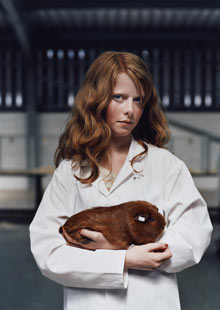
Harriet and Gentleman Jack, by Jooney Woodward, has won the Taylor Wessing Photographic Portrait Prize for 2011. Photograph: Jooney Woodward/PA.

This piece is very striking and immediately shows character and depth. Her work is taken in film, which was seen as unusual at the exhibition, however I think it gives certain uniqueness to photographs that you can't get with digital. Her red hair and the juxtaposition of the Guinea Pig is dominating the image, against the white overalls, it really shows that the two characters are as important as each other.

 "I prefer the quality and depth you get from using film; unfortunately it's a dying art."-Woodward.

The picture was taken with a Mamiya RZ medium format camera, which I am currently learning to master at University. Our portraiture project is based around medium format, so this image is a huge inspiration.

"I don't mess around with Photoshop so what you see is what you get. Enhanced images can portray a false sense of reality, whereas my work celebrates the people and places as they appear every day," she said.


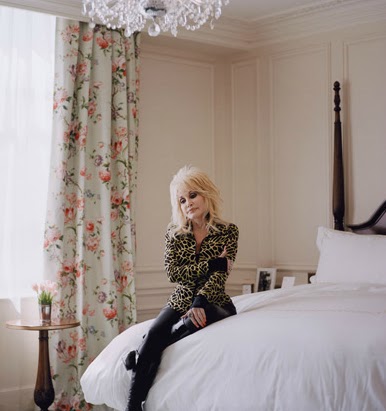
Dolly Parton by Zed Nelson, 2011 © the artist


Andie

by David Knight © the artist

His portrait of 15-year-old Andiee Poetschka, was commissioned
 by Loud for the Cerebral Palsy Alliance to raise awareness of the condition throughout Australia. He says:

‘I wanted the portraits to be positive and to convey the kids in an uplifting way
 You don’t immediately notice Andiee is in a wheelchair; you just see a
 beautiful young woman. The image doesn’t demand you look at it, but gently
draws you in.’

(Information taken by The NPG website)